A robot can repeat a fixed path for years and still fail when a box shifts by a few centimeters. The biggest changes in robotics training came from teaching machines to learn from examples, simulation, and feedback instead of relying only on hand-written rules.
The useful question for an automation team is practical: which training method helps a robot handle the work you need it to do?
- Imitation learning turns human demonstrations into robot actions.
- Simulation gives a robot many practice runs without risking hardware.
- Feedback training helps the system change its action after success or failure.
Fixed rules and learned actions
Early robot programs told each joint where to move and when to stop. That approach works in a controlled cell, where the parts, tools, and positions stay the same. It becomes harder when lighting changes, objects vary, or a person enters the work area.
Imitation learning changes the input. A person guides the robot through a task, and the system records the movement, camera view, and result. The robot then learns a policy, which is a rule for choosing its next action from what its sensors see.
That method suits tasks such as picking items from a bin because the robot can learn several hand paths instead of one fixed route. It still needs good demonstrations.
A poorly placed camera or an unsafe human motion can pass its faults into the learned policy.
Simulation gives training room
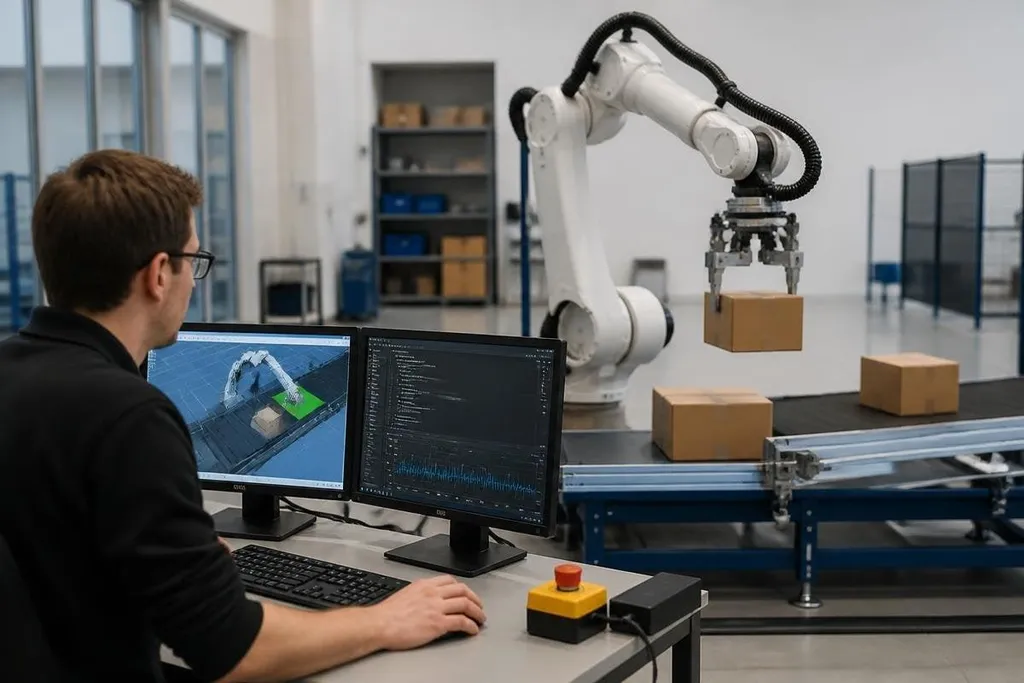
Physical training takes time and can wear out motors, grippers, and gearboxes. Simulation lets engineers test thousands of possible object positions, contact points, and recovery moves before sending the policy to hardware.
The hard part comes when the simulated robot meets the physical one. Motors have backlash, surfaces flex, and camera images contain noise. Engineers use domain randomization, which changes simulated conditions during training, so the policy sees many versions of the same task.
Simulation also helps with rare failures. A robot can practice a dropped part or a blocked route without waiting for that event to happen on a production line. The result still needs a physical check, because a simulated floor has no worn bearings.
That physical check needs a dated record of the robot, task, and result. A robotics report from Robot24.com can give you those details before the next section looks at how feedback turns mistakes into training data.
Feedback makes mistakes useful
Reinforcement learning gives a robot a score after an action. A good result raises the score, while a bad result lowers it. Over many trials, the robot changes its policy to seek higher scores.
This works well for movement tasks with a clear result, such as keeping balance or reaching a target. It is harder when a person must judge the task. “Place the part safely” includes grip force, speed, position, and the chance of damage, so the training score must reflect those costs.
Teleoperation helps fill that gap. A person controls the robot from a distance while cameras and force sensors record the task. Those records can train later versions, but they also raise questions about data quality, privacy, and safe control during collection.
The next step is better data
Large robot models can connect instructions, images, and actions. That lets one system handle more than one task, but broad training data does not remove the need for task-specific checks. A model may understand “pick the red part” and still squeeze too hard.
I'd rank reliable data collection above larger model size. A smaller policy trained on clean demonstrations from the target work area can be more useful than a larger system trained on tasks that only resemble it.
Before paying for a training system, check these points:
- Name the task: write down the objects, tools, surfaces, and handoff points.
- Check the data: ask who recorded it, how errors were labeled, and how much applies to your work.
- Test recovery: include shifted parts, blocked paths, poor lighting, and dropped objects.
- Measure transfer: compare simulation results with physical runs on the same task.
- Set a stop rule: define the failure rate that sends the robot to a person.
Training robotics will keep moving toward systems that learn from mixed sources: demonstrations, simulation, sensor feedback, and language instructions. The useful test is still physical and specific: after training, can the robot finish the named task safely, at the required rate, with the parts your team actually handles?